|
Simulating the Texts of the Constitution of the Republic of Iraq (2005) and the Principles of Sustainable Development
2026-01-28
Simulating the Texts of the Constitution of the Republic of Iraq (2005) and the Principles of Sustainable Development
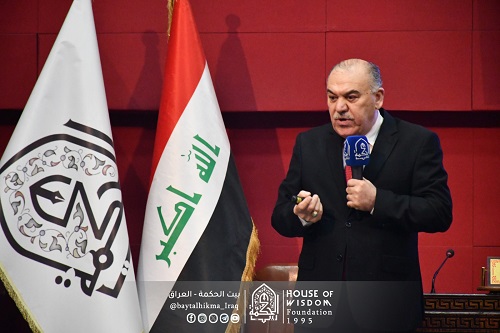
Bayt al-Hikma – Department of Legal Studies, in cooperation with the Department of Law at Al-Mansour University College, organized a scientific seminar entitled “Simulating the Texts of the Constitution of the Republic of Iraq (2005) and the Principles of Sustainable Development” at Al-Khwarizmi Hall in Bayt al-Hikma on Monday, 26 January 2026. The seminar was attended by a distinguished academic and legal audience, including a number of faculty members and law students.
The session was chaired by Legal Advisor Dr. Izz al-Din Al-Muhammadi, Supervisor of the Department of Legal Studies at Bayt al-Hikma, while Dr. Thikra In‘am Ghaib served as the session rapporteur.
The seminar highlighted the importance of enhancing the applied understanding of constitutional texts and linking them to the principles of sustainable development, thereby contributing to the consolidation of constitutional culture among law students. It also supported the adoption of simulation as a modern educational approach that develops legal analysis and critical thinking skills, and strengthens cooperation between academic institutions in promoting legal awareness and building a state based on institutions and the rule of law.
The seminar’s themes were interconnected and reflected a coherent academic progression, beginning with the civilizational and institutional framework of Bayt al-Hikma, moving through the academic role of Al-Mansour University College, and culminating in the educational vision and practical application. This progression served a shared objective: transforming constitutional texts from theoretical material into conscious legal practice.
The first theme, entitled “Bayt al-Hikma: The First Civilizational Center in Iraq,” was presented by Legal Advisor Dr. Izz al-Din Al-Muhammadi. He reviewed the historical and civilizational role of Bayt al-Hikma as a pioneering scientific institution that fostered knowledge and thought, the extension of its influence to Western countries, and its contemporary contribution to supporting legal and intellectual research and consolidating constitutional culture.
The second theme was presented by Professor Dr. Ra‘ad Fajr Fattih, Head of the Department of Law at Al-Mansour University College, who provided a brief overview of the department. This theme complemented the institutional framework by highlighting the department’s mission in preparing legally aware cadres, academically and practically qualified, and its role in linking legal education to societal needs.
In the third theme, entitled “Visions and Message of Simulating the Texts of the 2005 Constitution,” Assistant Lecturer Sawsan Khairi Abdullah, a faculty member in the Department of Law at Al-Mansour University College, shed light on the educational and applied dimensions of simulating constitutional texts and their importance in reinforcing students’ practical understanding of the constitution and linking legal texts to the legal and executive reality.
In the concluding theme, a group of law students participated in “The Practical Application of Simulation,” presenting applied models for simulating constitutional texts in the context of sustainable development. This contributed to enhancing skills in legal analysis, dialogue, critical thinking, and understanding the mechanisms of constitutional practice.
The seminar witnessed distinguished academic interaction that reflected the importance of the topic and the pivotal role of academic and scientific institutions in consolidating constitutional thought in support of development pathways.
The seminar was attended by a select group of professors, academics, and researchers specialized in legal affairs, who enriched the sessions through scholarly interventions and commentary, lending the seminar a distinguished academic and dialogical character. |