.jpg)
.jpg)
receipt of scientific research

Search
Monthly activity schedule
Statistics
Current Visitors No : 27
Today Visitors No : 1237
Yesterday Visitors No : 1632
Total Visitors No : 1952869
Today Visitors No : 1237
Yesterday Visitors No : 1632
Total Visitors No : 1952869
Complaints and suggestions

From Photo Gallery

E-IRAQ
Newsletter
News Details
The Jaafari Personal Status Law and Its Effects on Iraqi Society
08-04-2026
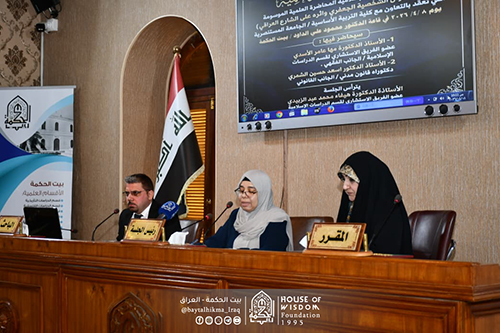
The Ja'fari Personal Status Law and Its Impact on Iraqi Society
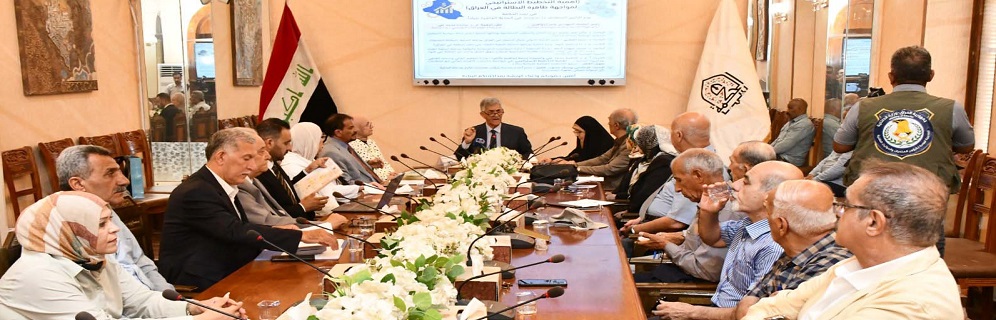
Bayt Al Hikma– Department of Islamic Studies, in cooperation with the College of Basic Education, organized a scientific lecture entitled “The Ja'fari Personal Status Law and Its Impact on the Iraqi Street” on Wednesday, April 8, 2026, at Dr. Mahmoud Ali Al-Daoud Hall in the House of Wisdom. The event was attended by the Chairman of the Board of Trustees of the House of Wisdom, Dr. Qahtan Naama Hassan Al-Khafaji, and Board Member Dr. Raed Akla Al-Zaidi.
The session was chaired by Prof. Dr. Haifa Mohammed Abdul Al-Zubaidi, a member of the advisory team of the Department of Islamic Studies, who outlined the major transformations witnessed by the personal status law in Iraq—particularly following the issuance of Law No. (1) of 2025. This law permits the application of Ja'fari rulings alongside Personal Status Law No. (188) of 1959, thereby opening the way for legal pluralism in family-related matters such as marriage, divorce, and child custody, based on sectarian affiliation and the choice of the parties involved.
The researchers discussed the jurisprudential and legal dimensions of the amendments to the Ja'fari Personal Status Law and their direct impact on the structure of the Iraqi family, as well as their social implications. Opinions varied between supporters, who see it as reinforcing sectarian particularity, and those who express reservations due to the potential disparities it may create in rights and obligations.
Prof. Dr. Maha Amer Al-Asadi, a member of the advisory team of the Department of Islamic Studies, presented her research paper highlighting the most prominent jurisprudential challenges related to child custody that have arisen in the application of the law in comparison with Ja'fari jurisprudence. She examined the legal foundations upon which the law is based, noting that the codified law tends to take into account the social and practical realities of the family, whereas Ja'fari jurisprudence relies on more traditional frameworks that may prioritize paternal guardianship at certain stages.
Dr. Asaad Hussein Al-Shammari, a specialist in civil law, emphasized a legal analytical reading of the law. He reviewed the legislative structure concerning the age of marriage, alimony, and the proposed amendments, explaining their impact on the Iraqi legal system, the extent of their compatibility with existing laws, and evaluating both the positive aspects and the challenges that may arise in its implementation—particularly in regulating marital relations and safeguarding mothers’ rights.
At the conclusion of the lecture, the Chairman of the Board of Trustees of the House of Wisdom presented certificates of appreciation to the participating researchers.
The lecture witnessed distinguished attendance from professors, researchers, and undergraduate and postgraduate students, who enriched the session through questions and scholarly discussions, adding an interactive dimension that reflected the importance of the topic and the depth of interest in it.
More News
The vision and mission

Strategy Plan

FREE books

Film
Change the value of the Iraqi currency .. Benefits and costs Seminar held by the Department of Economic Studies
Clock
Visitor Map
mop

Energy subsidies and emissions reduction