
receipt of scientific research

Search
Monthly activity schedule
Electronic inquiries

Statistics
Today Visitors No : 2936
Yesterday Visitors No : 3921
Total Visitors No : 2913308
Complaints and suggestions

UR- E- GET

From Photo Gallery

E-IRAQ
Newsletter
News Details
Transitional criminal justice
09-03-2026
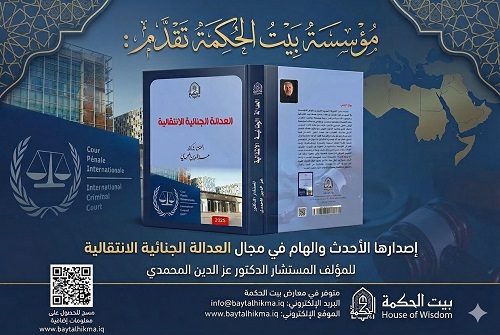
Transitional Criminal Justice
Amid the growing international interest in issues of global justice, the Bayt al-Hikma (House of Wisdom) published a book titled “Transitional Criminal Justice” as part of its authorship project series. The book was written by Izz al-Din Al-Muhammadi, Head of the Department of Legal Studies at Bayt al-Hikma.
The book highlights the importance of achieving justice and preventing impunity, which contributes to spreading legal awareness about managing the post-conflict phase. It presents a scientific perspective that can be utilized in building fair and effective legal institutions.
In his book, Al-Muhammadi reviews the historical roots of the idea of international criminal justice, which emerged clearly after the World War II. At that time, the world witnessed the first international trials for perpetrators of major crimes through the Nuremberg Trials and the International Military Tribunal for the Far East. These trials marked a decisive turning point in the development of international law, establishing the principle that individuals can be held accountable for international crimes.
The author also discusses in the book’s chapters the concept of transitional criminal justice and its importance in societies emerging from conflicts or periods of serious human rights violations. He explains its role in uncovering the truth, achieving justice for victims, and laying the foundations for societal reconciliation.
Furthermore, the author examines the major crimes that fall within the jurisdiction of international criminal justice, such as genocide, crimes against humanity, war crimes, and the crime of aggression, clarifying the legal standards adopted by the international community in defining these crimes and prosecuting their perpetrators.
Finally, the book concludes by highlighting the pivotal role played by the International Criminal Court as the first permanent international criminal court responsible for prosecuting those accused of committing the most serious crimes that threaten international peace and security.
The vision and mission

Strategy Plan

FREE books

Film
Change the value of the Iraqi currency .. Benefits and costs Seminar held by the Department of Economic Studies
Clock
Visitor Map
mop

Energy subsidies and emissions reduction